
Have you ever found yourself wondering, “Is this property worth it?” while looking at a potential rental? You are not alone. When you’ve invested in your first property or are continuing to build your current rental portfolio, you have several factors to evaluate to determine what represents a good return on investment.
The truth is, there’s no magic number that works for everyone. An “exciting” return for one person might be a deal breaker for another. It’s truly reliant on both your market and financing, as well as your personal goals and how active an investor you want to be. However, once you figure out which metrics are important and what drives them, the process of evaluating a deal will become more scientific than trial-and-error. Read along as this post breaks down what a genuinely good rate of return looks like for a rental property business.
How to Calculate ROI of a Rental?
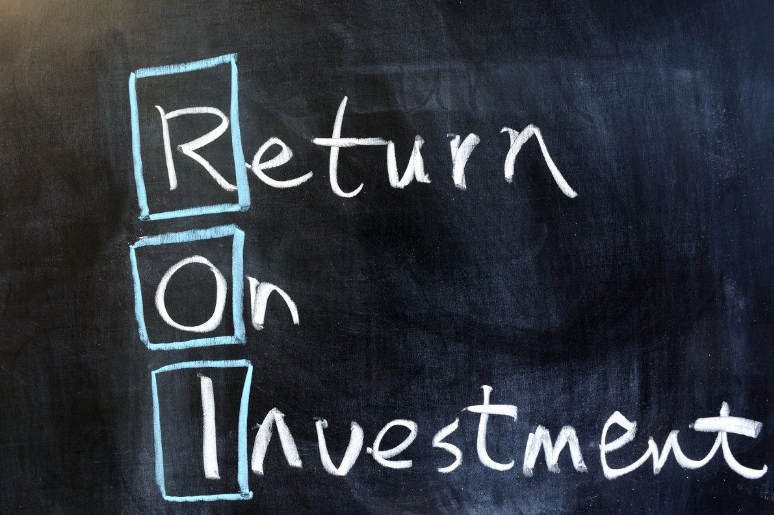
Calculating your rental ROI doesn’t require too much work or a finance degree. The formula is straightforward: ROI = (Annual Net Profit ÷ Total Investment) × 100
The net profit you earn from your rentals is just what is left over after you subtract your operating expenses from the rental income you receive. When you consider your operating expenses, include mortgage payments, property taxes, insurance, maintenance, and any time the property is unoccupied. When you add together all of the amounts you have invested in the property, you will have a total investment. Your total investment includes the down payment you made, the closing costs, and any rehabilitation costs incurred before you had your first tenant.
Thus, you have a 10% return on investment if you invest $60,000 in a property and finish up with $6,000 in net profit at the end of the year. Check this number prior to purchasing, not after. It is the most obvious early indicator of a property’s value. Work with a San Antonio, Texas property management team to ensure your rental income will be managed effectively.
What is a Good Rate of Return?
This is where the majority of investors want a direct answer, and it’s reasonable to do so. For a rental property to be deemed a good investment, a widely used benchmark is 8% to 12% ROI. In a low-risk, high-appreciation market, some investors are satisfied with 6%, while others won’t touch anything below 8%.
Another quick gut check that many landlords employ is the “1% rule,” which states that your monthly rent should be at least 1% of the property’s purchase price. The ideal monthly rent for a $150,000 house is $1,500. Although it’s not a perfect rule, it makes it easier to swiftly filter deals.
What constitutes “good” is also determined by the area in which you invest. In high-cost cities, returns of 5% to 6% can be competitive because property values rise quickly. However, in smaller and cheaper markets, you would expect to make greater cash returns relative to property appreciation, which typically occurs at a slower pace. At the end of the day, the rate of return that will work best for you is based on your goals, how much risk you are willing to assume, and still puts money in your pocket consistently.
Factors that Can Affect the Rate of Return
1. Tenant Turnover and Management Strategy
The amount of money you earn from your investment is negatively affected when a tenant moves out, and the impact is often more severe than a landlord expects. This effect is caused by the loss of rental income while the unit is vacant, as well as the costs a landlord incurs to prepare the unit for the next tenant. These costs will quickly add up to greater than the landlord initially expected.
To reduce tenant turnover in rentals, landlords should communicate clearly with their tenants from the start of their leases. Landlords can self-manage their property and save 8-12% on monthly property management fees. However, managing property takes time, and time has a monetary value. On the other side, tenants who live in a poorly managed property will move on faster due to having unaddressed maintenance issues or poor screening by their landlord. Therefore, happy tenants will remain in their units longer and pay rent more consistently.
2. Financing and Interest Rates
Your rental property financing can significantly affect your monthly take-home pay, depending on how the interest rate affects your monthly payment. A lower interest rate means a smaller monthly payment and, therefore, more rental income. This theory holds true for rising rates: they narrow the spread between the rent you receive and the mortgage expense you pay.
Understanding the loan’s timing and structure is important. A fixed-rate mortgage will shield you from future interest rate increases. An adjustable-rate mortgage, on the other hand, may seem more attractive now but could subsequently erode your returns because of higher future payments. Always compute your return using an interest rate higher than the one quoted before closing the rental transaction to establish how much cushion you have.
3. Location & Supply-Demand Dynamics
The location of a property is probably the most important factor to consider. A good rental is located in a high-demand area with good schools, a low crime rate, and easy access to jobs, which will likely generate higher rental income and thus lower vacancy rates than a comparable property in a low-demand area. That directly translates into better returns.
This has to do with the supply and demand of the housing market. When rental supply is limited, and many people are looking for a place to rent, landlords have greater pricing power. When there is an oversupply of rentals, and you are competing for renters to fill your unit, you may have to lower your rent to attract tenants.
4. Operating Expenses and Hidden Costs
Many first-time landlords are shocked by this. Operating expenses include more than just a mortgage. Taxes on the property, insurance costs, routine maintenance, and property management will all cut directly into your investment return. In addition to this, your total operating costs can add up quickly, generally much more than you expected.
There are the unexpected costs, such as a broken water heater, roof repairs, or a tenant who moves out, leaving you with three months of vacancies to fill. Honestly, these are very common and just another part of being a rental property owner.
You should consider putting aside around 10% to 15% of your rental income each year for repairs and maintenance. Many investors who underestimate their expenses are generally the ones complaining that their property is not performing as expected. When doing your math, be sure to include the actual costs and not the more optimistic costs of performing your rental.
Conclusion
There’s no one-size-fits-all requirement for finding the right mix to create an ideal rental property, but you now have the information available to determine what best fits your unique needs. You should accurately run your ROI, assess your true costs, and track the variables that might affect your overall results as they change over time. Investors who create long-term rental income often aren’t the ones who find perfect deals; rather, they are the ones who calculate their potential profit before committing. By understanding your numbers, you will be better able to spot the right opportunities.